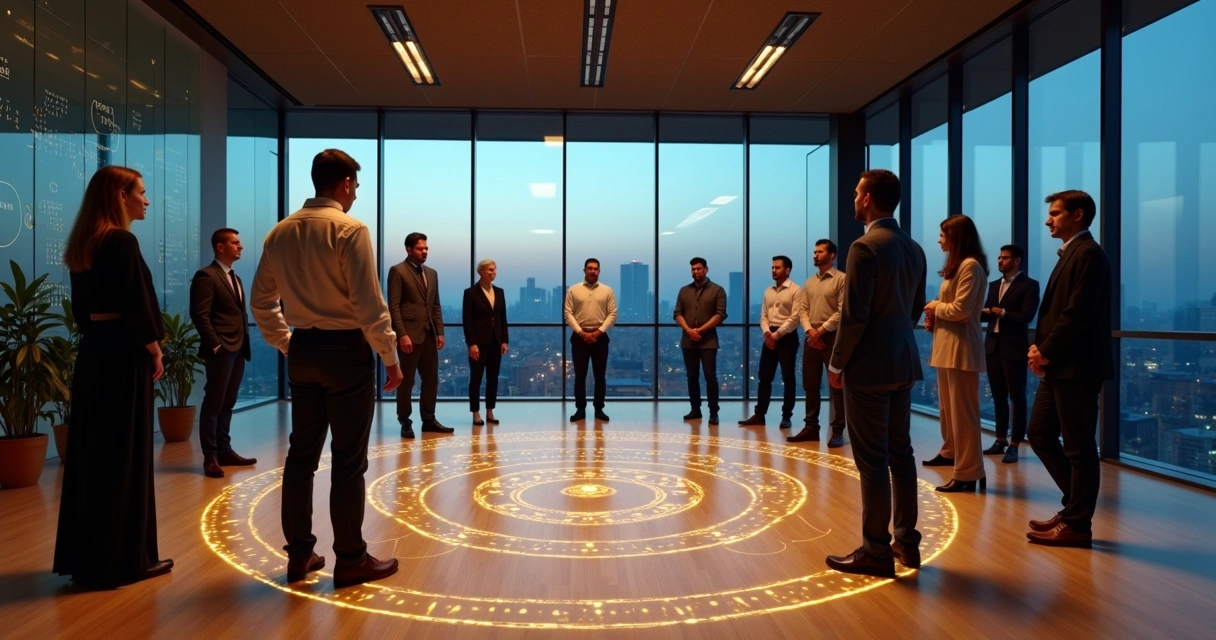
We often think a company shows itself through mission statements, annual reports, and formal policies. Yet in our experience, the truer picture appears in repeated acts that seem small at first. How meetings begin. How birthdays are handled. Who speaks first. Who gets thanked. Who gets ignored.
Company rituals are not decorative habits. They are visible expressions of hidden consciousness.
When a team pauses to listen before deciding, that ritual says something. When leaders rush into a room late and distracted, that says something too. Rituals reveal what a group has normalized at the emotional and relational level. They show whether people act from fear, trust, control, respect, or shared meaning.
We have seen this in simple scenes. A new employee joins a weekly meeting. No one introduces them. The agenda moves on. Nothing dramatic happens, yet everyone learns a lesson. In another workplace, the same moment becomes a brief welcome, a round of names, and one sincere question. Again, a lesson is learned. Ritual teaches without announcing that it is teaching.
Why rituals matter more than they seem
Rituals shape culture because they repeat. A single action may be random. A repeated action becomes a message. Over time, that message settles into the body of the organization. People stop asking why things are done that way. They simply adapt.
That is where embedded consciousness appears. We use that phrase to describe the inner pattern that has become normal inside a group. It may be grounded, reactive, generous, defensive, open, or rigid. Whatever it is, rituals carry it.
Research from Stanford Graduate School of Business points out that organizational culture lives in everyday practices, including rituals, celebrations, and farewells. This matters because culture is not only a declared value. It is a repeated experience.
Ritual is culture in motion.
When we pay attention to these moments, we begin to see that rituals do two things at once:
They reflect the current state of a company.
They reinforce that state through repetition.
They teach newcomers what is safe, rewarded, and expected.
This is why even a short weekly routine can carry deep meaning. It is not just procedure. It is training for attention, emotion, and relationship.
What rituals reveal about leadership
Every ritual has a designer, even when no one admits it. Sometimes it was built on purpose. Sometimes it formed by accident and stayed because nobody challenged it. In both cases, leadership is involved, since leaders allow, model, or reshape what repeats.
The way leaders show up inside rituals tells people what kind of inner state has authority.
If leaders interrupt often, the ritual teaches speed over thought. If they ask for feedback but punish honesty, the ritual becomes theater. If they make room for silence before hard decisions, people learn that reflection has value.
We think this is where many organizations misread themselves. They focus on what is written and miss what is enacted. A company may speak about care while rewarding exhaustion. It may speak about inclusion while letting the same voices dominate every room.
One of the clearest signs of embedded consciousness is the emotional tone that rituals produce. Consider a regular check-in. In one place, it feels like surveillance. In another, it feels like orientation. The structure may look similar from the outside, but the consciousness beneath it is different. People feel that difference immediately.
Common rituals and the messages they send
Not all rituals carry the same weight, but many offer strong clues about collective awareness. We can learn a lot by looking at a few recurring forms.
Here are some examples that often reveal more than expected:
Meetings show whether the company values presence, hierarchy, listening, or display.
Recognition moments reveal what kind of effort gets noticed and what kind stays invisible.
Onboarding routines show whether belonging is treated as human care or mere administration.
Conflict rituals reveal whether tension is faced directly, hidden, or passed downward.
Departures and farewells show whether people are treated as disposable or as part of a living history.
We sometimes notice that the strongest signal is not in celebration but in strain. Watch what happens after a mistake, during pressure, or when results fall short. Those moments expose the real ritual of accountability. Is there blame, inquiry, repair, silence, or panic?

Rituals, meaning, and shared emotional life
Rituals do more than organize time. They help people make sense of where they are and who they are with. This is why even simple shared acts can strengthen connection when they are honest and consistent.
Research discussed by Harvard Business School suggests that workplace rituals, such as shared routines and symbolic activities, can deepen team cohesion and create more meaning in work. We find this convincing because people do not bond through slogans. They bond through repeated experience.
A team meal after a hard quarter can become more than a meal. A moment of silence before a difficult conversation can become more than silence. If the action is sincere, it helps regulate the group. It says, “We will not move as machines. We will move as people.”
What repeats shapes what people feel.
Still, not every ritual is healthy. Some drain energy while pretending to build unity. Forced fun, empty praise, public pressure, and staged vulnerability can all become rituals. When that happens, people comply outwardly and withdraw inwardly.
We should ask a simple question: does this ritual increase trust and clarity, or does it hide fear with polish?
How healthy rituals are built
Good rituals do not need to be grand. In fact, the best ones are often plain, clear, and easy to sustain. What matters is the state of mind behind them and the consistency with which they are held.
We suggest looking at ritual design through three lenses:
Attention. What does the ritual ask people to notice?
Emotion. What feeling does it permit, calm, or provoke?
Relationship. How does it shape the way people meet each other?
If a ritual fails in all three, it usually becomes mechanical. If it supports all three, even briefly, it can shift the atmosphere of an entire team.
California Management Review cites survey evidence that 81% of executives who see their organizations as adaptable also view culture as a strategic asset. We read this as a sign that culture is not soft background material. It affects how groups respond, recover, and stay aligned under change.

That kind of adaptability does not appear only in strategy sessions. It is built through repeated human patterns. Ritual is one of them.
Conclusion
When we want to understand a company, we should watch its rituals before we read its promises. Repeated actions show what the group honors, what it fears, and what it has learned to ignore. They reveal whether consciousness in the organization is scattered or centered, controlling or receptive, superficial or mature.
If we want better culture, we must change what is repeated, not only what is declared.
That work begins with honest observation. Which rituals create presence? Which ones deepen trust? Which ones quietly train people to disconnect from themselves and each other? The answers are rarely hidden. They are happening in plain sight, every week, often every day.
Frequently asked questions
What are company rituals?
Company rituals are repeated workplace actions that carry shared meaning. They can include how meetings start, how wins are marked, how new people are welcomed, and how teams respond to loss, conflict, or change.
How do rituals show company values?
Rituals show company values by turning ideas into behavior. A company may say it values respect, openness, or care, but rituals reveal whether those values are truly practiced in everyday moments.
Why do companies have regular rituals?
Companies have regular rituals because repetition creates stability, shared expectations, and social meaning. These routines help people understand how to act together, especially during uncertainty or pressure.
How can rituals boost team consciousness?
Rituals can boost team consciousness when they create space for attention, honesty, and presence. A thoughtful check-in, a respectful closing, or a moment of reflection can help teams become more aware of how they think, feel, and relate.
What are examples of workplace rituals?
Examples of workplace rituals include weekly check-ins, onboarding welcomes, shared meals, recognition rounds, project closings, farewell gatherings, and short pauses before difficult decisions. What matters most is not the form alone, but the awareness behind it.